

VAT Exempt vs Zero-Rated UAE: The Complete Business Guide for 2025
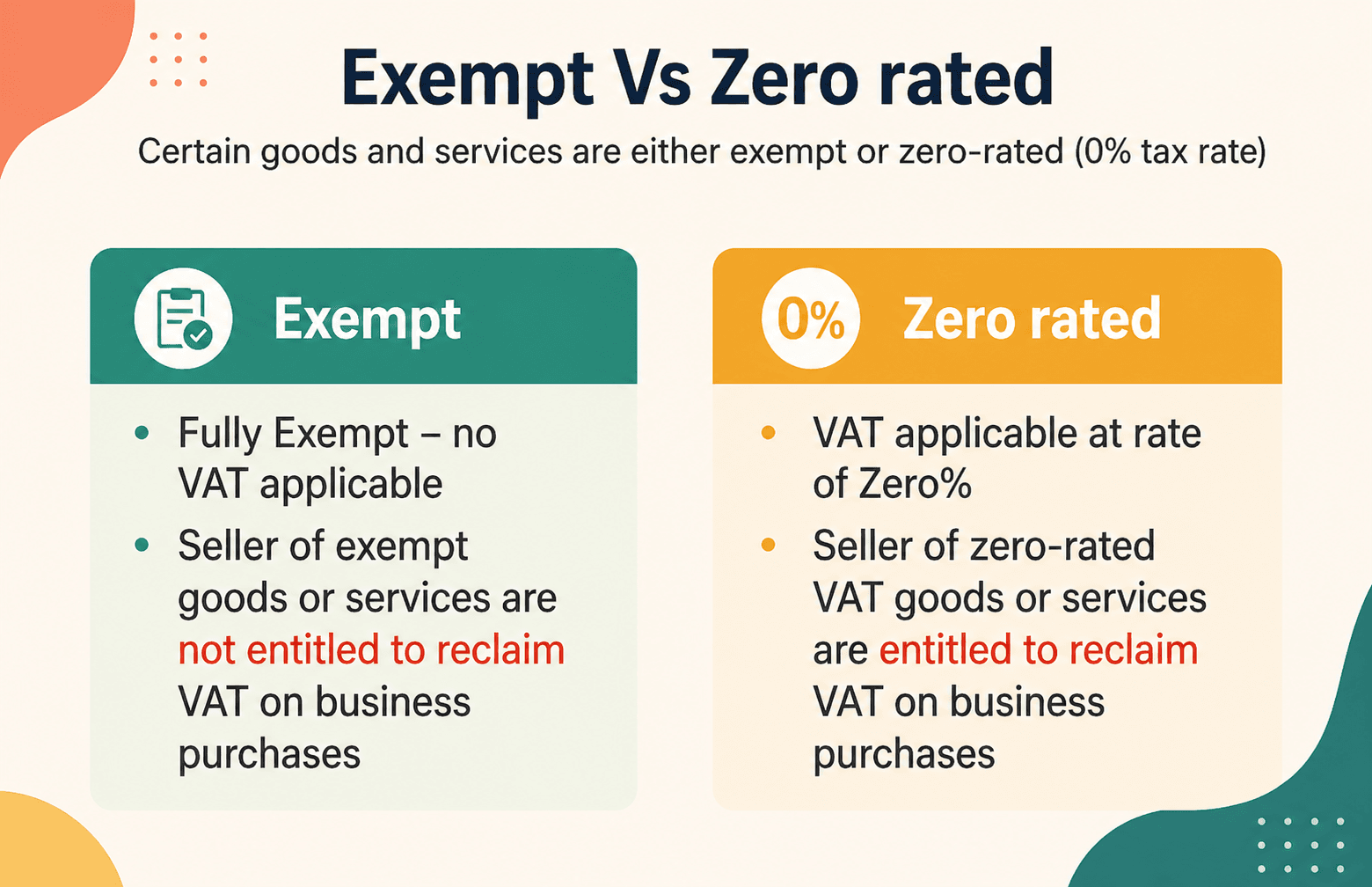
One of the most financially consequential misunderstandings in UAE VAT is the difference between zero-rated and exempt supplies. On the surface, both appear to result in the same outcome — no VAT charged to the customer. In practice, they operate under entirely different rules, carry different rights for your business, and making the wrong classification can lead to incorrect VAT returns, underpaid tax, and direct FTA penalties.
This guide explains the legal distinction between VAT-exempt and zero-rated supplies in the UAE, which categories fall under each, how the classification affects your input tax recovery, and what your business must do to classify its supplies correctly and stay fully compliant with FTA requirements.
What Is UAE VAT: A Quick Foundation
The UAE introduced Value Added Tax on 1 January 2018 at a standard rate of 5%. VAT is applied at each stage of the supply chain and is ultimately borne by the end consumer. Businesses registered for VAT collect output tax on their sales and recover input tax on their eligible purchases — paying the net difference to the FTA each quarter.
However, not all supplies are taxed at 5%. The UAE VAT framework recognises three categories of supply:
- Standard-rated supplies — taxed at 5%
- Zero-rated supplies — taxed at 0%
- Exempt supplies — outside the VAT system entirely
Understanding the difference between the last two is critical for every UAE business operating in affected sectors.
What Are Zero-Rated Supplies in the UAE?

A zero-rated supply is a taxable supply on which VAT is charged at 0%. The word “taxable” here is the key. Even though no VAT is actually collected from the customer, zero-rated supplies are still part of the UAE VAT system. This means:
- The supply must be reported on your VAT return
- Your business retains the full right to recover input VAT on costs related to making that supply
- The zero-rated status must be documented and supported with evidence
Zero-rated treatment is not a relaxation of VAT rules — it is a deliberate policy decision by the UAE government to remove the VAT cost from specific categories of goods and services while keeping those supplies within the formal tax framework.
Zero-Rated Supply Categories Under UAE VAT Law
The following categories of supply are zero-rated under the UAE VAT Law and its Executive Regulations:
- Exports of Goods Outside the UAE Goods physically exported from the UAE to a destination outside the GCC implementing states are zero-rated, provided the exporter holds documentary proof of export such as customs clearance documents and shipping records.
- International Services Services supplied to customers outside the UAE — where the benefit is received outside the UAE — are generally zero-rated. This includes consultancy, marketing, and professional services delivered to overseas clients.
- International Transport of Goods and Passengers Transport services that begin or end outside the UAE, or pass through UAE territory as part of an international journey, are zero-rated.
- Certain Food Items A defined list of basic food items is zero-rated under the UAE VAT Executive Regulations. This list is specific and limited — businesses in the food sector must verify each product against the published schedule rather than assuming broad zero-rating applies.
- Healthcare Services and Related Goods Preventive and basic healthcare services provided by qualifying healthcare providers, along with related medicines and medical equipment, are zero-rated. Cosmetic and elective procedures are generally standard-rated.
- Educational Services Pre-school through higher education services provided by recognised institutions, along with related educational materials and school transport, are zero-rated.
- First Supply of Residential Buildings The first sale or lease of a newly constructed residential property is zero-rated. Subsequent supplies of the same residential property are exempt (covered below).
- Investment Precious Metals Gold, silver, and platinum of qualifying purity traded for investment purposes are zero-rated.
What Are Exempt Supplies in the UAE?
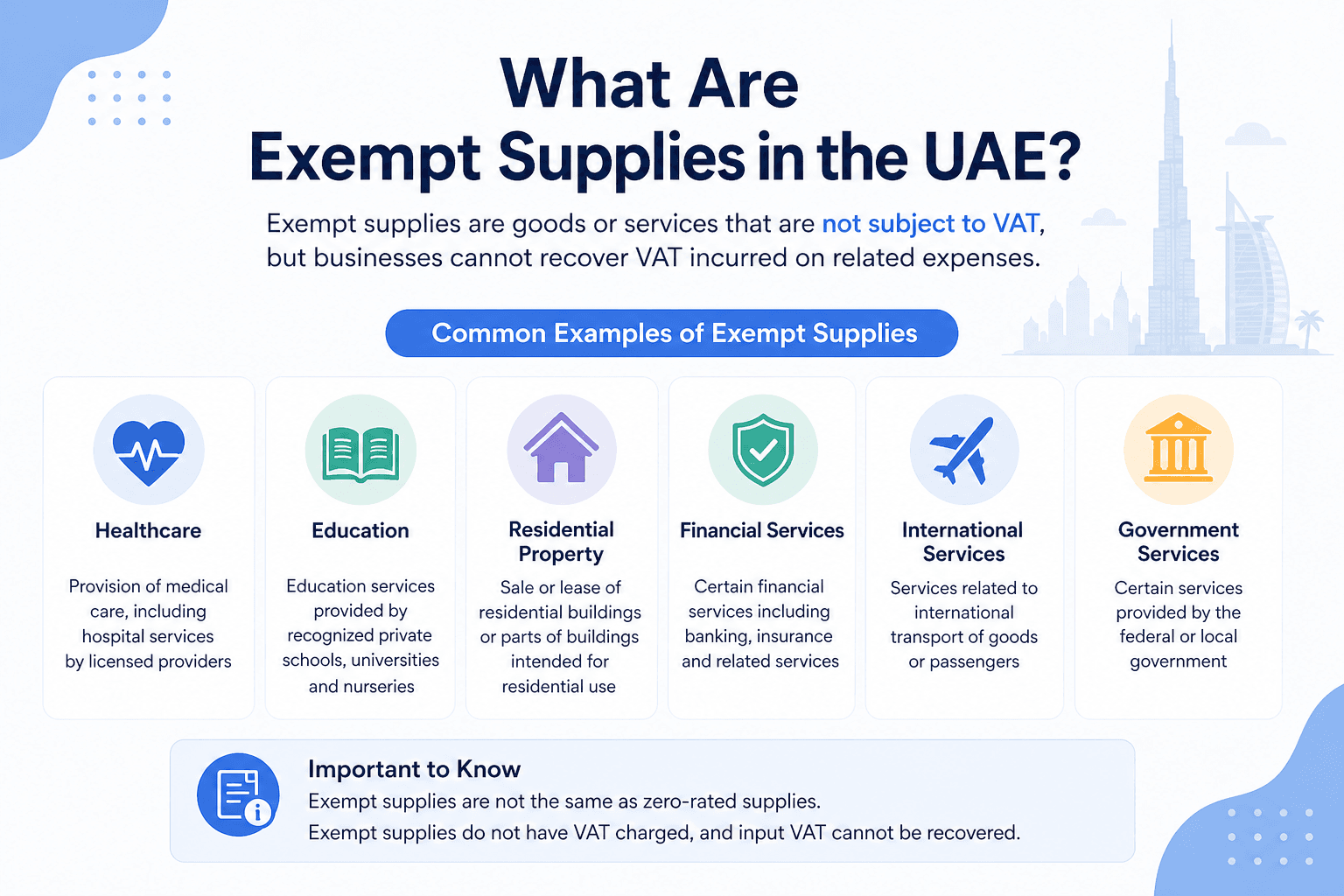
An exempt supply is fundamentally different from a zero-rated supply. An exempt supply is outside the VAT system entirely — it is not taxable, it is not reported as a taxable supply on your VAT return, and — critically — your business cannot recover input VAT on costs directly related to making exempt supplies.
This last point is where the financial impact becomes significant. A business that makes exempt supplies and attempts to recover input VAT on related costs is overclaiming, which constitutes a VAT error and carries penalties of up to 50% of the overclaimed amount when identified by the FTA.
Exempt Supply Categories Under UAE VAT Law
The following categories are exempt from UAE VAT:
- Financial Services Certain financial services where the consideration is implicit — such as margin, spread, or interest — are exempt. This includes life insurance, certain banking services, and fee-free financial products. Financial services that charge explicit fees are generally standard-rated.
- Residential Property — Subsequent Supplies The second and subsequent sales or leases of residential property are exempt. Only the first supply by the developer or builder is zero-rated. This distinction is critically important for property investors and developers managing multiple transactions on the same asset.
- Bare Land The supply of undeveloped land with no infrastructure or improvement is exempt from VAT.
- Local Passenger Transport Local bus, metro, tram, and taxi services within the UAE are exempt from VAT.
Zero-Rated vs Exempt: The Critical Difference Explained
This table summarises the distinction that every UAE business must understand:
Feature | Zero-Rated | Exempt |
VAT charged to customer | 0% | None |
Is it a taxable supply? | Yes | No |
Reported on VAT return? | Yes | No (only in exempt column) |
Can you recover input VAT on related costs? | Yes — fully | No — blocked |
Risk of FTA penalty if misclassified? | Yes | Yes |
Example | Export of goods | Residential property resale |
The practical financial consequence of this difference is significant. A business making zero-rated supplies can recover all input VAT on costs used to make those supplies — effectively operating VAT-free on both sides. A business making exempt supplies cannot recover the input VAT on related costs, meaning VAT becomes an embedded business cost that reduces profit margins.
Partial Exemption: When Your Business Makes Both Types of Supply

Many UAE businesses make a mix of taxable supplies (standard-rated and zero-rated) and exempt supplies. This situation is known as partial exemption and requires a more complex VAT calculation.
Under partial exemption rules, your business must:
- Identify which input VAT is directly attributable to taxable supplies — fully recoverable
- Identify which input VAT is directly attributable to exempt supplies — not recoverable
- Calculate the proportion of residual input VAT (costs that relate to both) that can be recovered using an approved apportionment method
The FTA has published specific guidance on partial exemption calculations. Businesses that operate across both taxable and exempt activities — such as financial services firms, property companies, and healthcare providers — must apply these rules correctly on every VAT return.
Getting partial exemption wrong — either over-recovering or under-recovering — is one of the most common causes of VAT errors identified during FTA audits. The penalty for overclaiming input tax is up to 50% of the overclaimed amount, making accurate classification a direct financial priority.
The Most Expensive Mistakes UAE Businesses Make With VAT Classification
Based on FTA compliance activity and common filing errors, the following misclassifications are the most financially damaging for UAE businesses:
Mistake 1: Treating all healthcare as zero-rated Only preventive and basic healthcare is zero-rated. Cosmetic, elective, and non-essential procedures are standard-rated at 5%. Clinics that zero-rate all services are underpaying VAT and face significant back-payment liability plus penalties.
Mistake 2: Treating all financial services as exempt Financial services with explicit fees — advisory charges, arrangement fees, management fees — are standard-rated. Only implicit-margin services are exempt. Financial firms that misclassify fee income as exempt are underpaying output tax.
Mistake 3: Recovering input VAT on exempt supplies This is the single most common error in partial exemption businesses. Any business making residential property resales, providing local transport, or supplying bare land must block the input VAT on direct costs related to those supplies.
Mistake 4: Failing to hold export documentation for zero-rated goods Zero-rated treatment for exported goods is only valid when supported by customs documentation, shipping records, and proof of delivery outside the UAE. Without this evidence, the FTA will reclassify the supply as standard-rated and assess 5% VAT on the full value — plus penalties.
Mistake 5: Assuming the first property supply rule applies to all sales Only the first supply by the developer or builder is zero-rated. Once a property has been sold or leased once, all subsequent supplies of that same property by any owner are exempt — not zero-rated.
What Your Business Must Do to Classify Supplies Correctly
Correct VAT classification is not a one-time exercise. It must be applied consistently to every transaction, reviewed when your business activities change, and documented clearly to support your VAT returns in the event of an FTA audit.
The following steps protect your business:
- Map all your supplies against the UAE VAT Law categories Work with a qualified UAE tax consultant to formally classify every type of supply your business makes. Do not rely on assumptions or industry generalisations.
- Set up your accounting system to reflect correct classifications Your accounting software should be configured to apply the correct VAT treatment to each supply type automatically. Zoho Books, for example, allows you to set VAT codes at the product and service level to prevent manual classification errors.
- Apply partial exemption calculations correctly each period If your business makes both taxable and exempt supplies, your input tax recovery must be calculated using an FTA-approved method on every VAT return — not estimated or averaged across periods.
- Maintain classification evidence For zero-rated exports, keep all customs and shipping documents. For zero-rated healthcare and education, document the qualifying nature of each service. For exempt financial services, document how the consideration is structured.
- Review your classifications annually UAE VAT guidance is updated periodically. An annual review with your tax consultant ensures your classifications remain current and compliant with the latest FTA published positions.
Conclusion
Profitrack Accounting & Management LLC provides complete VAT advisory and compliance services for UAE businesses across all sectors. Our VAT classification services include:
- Full supply mapping and VAT classification reviews
- Partial exemption method design and calculation
- VAT return preparation with correct zero-rated and exempt reporting
- Voluntary Disclosure preparation for historical classification errors
- FTA audit support and representation
- Zoho Books configuration for automated VAT treatment
- Ongoing VAT advisory as your business activities evolve
We work with businesses in financial services, real estate, healthcare, education, trading, and professional services — all sectors where VAT classification directly affects profitability and compliance standing.